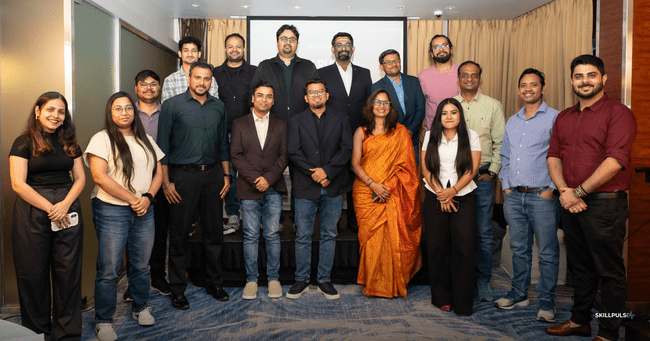
BENGALURU, India, 3rd October, 2026: Enqurious hosted the SkillPulse September Community Meet in Bengaluru on 25 September 2026. Technology leaders from Nike, Varaha, XCaliber Health, Sigmoid and Catalytics Datum argued that AI agents have made execution cheap and judgment scarce, and questioned whether the IT services pyramid, built on a wide base of junior engineers, can survive.
Key takeaways
- Execution is cheap. Judgment is scarce. AI enables junior engineers to ship in hours what once took a week, but it still can’t reliably tell them when the output is wrong. (Vishal Kuchanur, Varaha).
- The premium moves to "why". When anyone can build a working demo, what sets an engineer apart is explaining why an architecture, model, or evaluation was chosen (Sandeep Charan, Nike).
- In high-stakes domains, AI reads and drafts; software decides. In one paediatric emergency workflow, AI handles 4 of 16 steps (Akarsh Verma, XCaliber Health).
- If AI agents absorb much of the execution, firms must intentionally create opportunities for junior talent to build the practical experience and judgment that come from doing the work
- Tool knowledge is the weakest signal of readiness. Role readiness sits in domain knowledge, skills such as data modelling, and human skills (Amit Choudhary, Enqurious).
What is an AI-native workforce?
An AI-native workforce is a team in which people delegate execution to AI agents and are hired, trained, and measured on the judgment AI cannot supply: deciding what to build, checking whether the output is right for the context, and owning the outcome. The meet ran under the theme "Build AI native workforce to tap a trillion-dollar growth opportunity." The meet was the third SkillPulse gathering. Speakers came from climate tech, global retail, healthcare, and workforce skilling, and reached the same conclusion from very different businesses. "Execution is cheap. Judgment is not," as Akarsh Verma of XCaliber Health put it. "And we may be outsourcing it."
What is the "valley of competence" in AI engineering?
Our guest Vishal Kuchanur, Co-Founder and CTO of Varaha, framed the problem from inside a company where AI keeps operations running. Varaha, a nature-based carbon project developer, works with close to 200,000 smallholder farmers across more than a million acres. Every carbon credit it issues requires proof that a specific farmer carried out a specific activity on a specific piece of land. That proof once meant a person, a camera, and a spreadsheet, farm by farm. A team of under 30 engineers now builds and runs it with AI.
Vishal argued that AI has widened what he called "the valley of competence": the distance between an engineer who can produce a correct answer and one who can tell whether it is right for the context. Juniors now ship in hours what took a week, he said, but cannot yet tell when it is wrong. "Almost right is the most expensive kind of wrong." With every engineer now delegating work to agents, he has stopped hiring for a single layer of the stack and looks for engineers who own the outcome end to end.
Why engineering value is moving from "how" to "why"
Sandeep Charan, Director of AI Engineering at Nike and formerly of Walmart Global Tech, described the same gap from inside a global enterprise. Intelligence has become cheap enough, he argued, that reaching the 80th or 90th percentile of a discipline is now easy. Teams are compressing as product management and engineering converge.
If anyone can build a working demo, the demo stops distinguishing anyone. What matters, in Sandeep's view, is whether an engineer can explain why a particular architecture, model or evaluation was chosen: the same judgment Vishal placed on the far side of the valley. As intelligence commoditises, he said, empathy, negotiation and trust are what hold their value. "Intelligence has become so commoditised... what is going to hold ground is being human."
How healthcare AI handles risk when almost right is not acceptable
In most software, a wrong answer is an edge case. In healthcare, said Akarsh Verma, Director of Product Management at XCaliber Health, "every patient is one." He traced a single paediatric emergency visit through XCaliber's system, from discharge note to tracked outcome, across 16 steps. The AI model handles four. "The rest has to be right, every time." His rule is that language models read and draft, while deterministic software makes the decisions that carry clinical risk.
Akarsh, whose career runs through Ford, Home Credit, Thoucentric and Kimberly-Clark, then turned to the risk that tied the evening together. If agents absorb the execution, junior staff lose the practice through which judgment has always been built. XCaliber's response includes:
- one-year internships
- roles organised by problem rather than title
- what he called "a duty to question" the AI
Vishal had made the same case for his own team: give juniors their practice back on purpose, or "in five years there is nobody left to ask the question."
Why coding assessments miss role readiness
If judgment is the scarce asset, companies need a way to identify who possesses it . Amit Choudhary, Founder and CEO of Enqurious, argued that most organisations are looking in the wrong place. Knowing SQL, Python or Spark no longer distinguishes an engineer, he said, because AI already knows the tools better. Role readiness now sits in what surrounds the tools:
- domain knowledge
- skills such as data modelling and performance tuning
- the curiosity, empathy and storytelling Sandeep had placed at the centre of an AI-native team
Of the engineer who aces an assessment and is then stumped by real work, he said: "You just captured the weakest signal of all, code." Enqurious is building role playbooks that break every Data and AI role into its competencies and skills, drawing on more than 2 million skill tags captured across more than 15,000 assessments. A skill intelligence layer then maps each person against them.
Does the IT services pyramid model survive AI agents?
The roundtable took these arguments to the services business model directly. The panel:
- Nishant Khanna, Chief Delivery Officer, Catalytics Datum
- Sanket Adhikari, Director, Sigmoid
- Ashitha Mollera, Executive Advisor (Data & AI), former Managing Director and Global Head of Data and AI at Brillio
They were asked two questions every delivery leader now faces. When agents do the doing, does the traditional pyramid and bench model still hold? And how does a firm show a client or a CFO that investment in capability has turned into delivery outcomes?
The speakers had already sharpened both questions. Vishal had argued that the pyramid still works as a training structure, provided juniors get their practice back. Akarsh had shown how removing handoffs could let a team of 25 work as roughly 12 people alongside agents. Amit had argued that firms are assessing their people on the wrong signal.
For companies whose revenue has always tracked headcount, the arithmetic is changing, and the harder task is proving what their people can actually do.
SkillPulse magazine Edition 2: the Forward Deployed Engineer
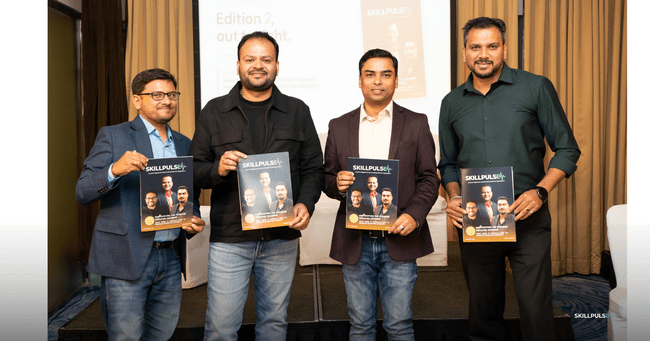
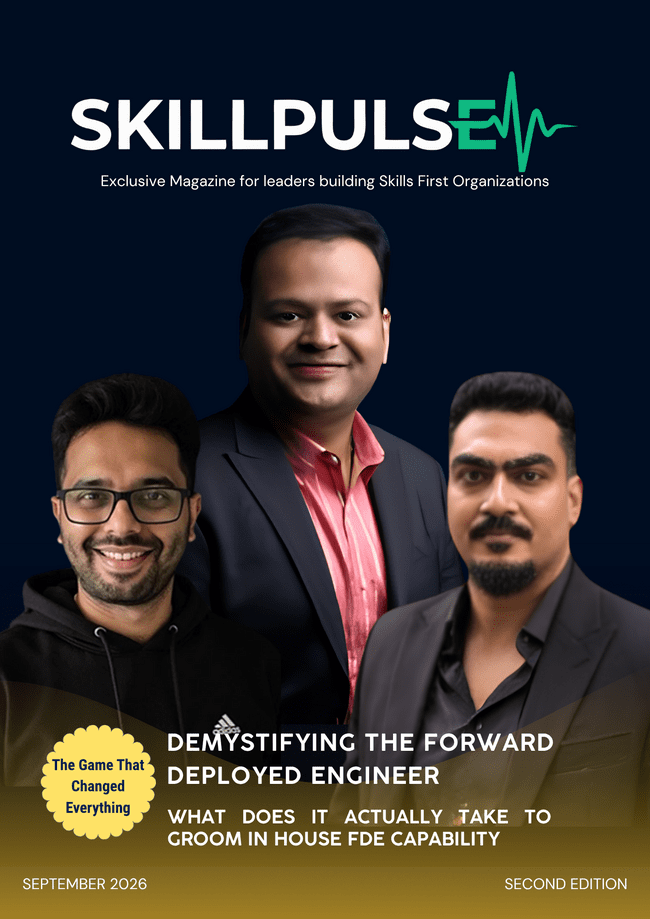
The meet also launched Edition 2 of the SkillPulse magazine, themed "Demystifying the Forward Deployed Engineer: what it takes to groom in-house FDE capability."
A Forward Deployed Engineer (FDE) is an engineer who works alongside the customer and answers for the result, not just the code. It is the role the evening kept describing. The edition's lead column, by Vishal Kuchanur, is titled "The Engineer Who Owns the Outcome."
Frequently asked questions
What is SkillPulse?
SkillPulse is a practitioner community for Learning & Development, Data and AI leaders, convened by Enqurious. It meets through short leadership talks, roundtables, and a companion magazine.
What is a Forward Deployed Engineer?
A Forward Deployed Engineer works alongside the customer and owns the business result, not just the code delivered. It was the theme of SkillPulse magazine Edition 2.
Does the IT services pyramid still work when AI agents do the execution?
Speakers at SkillPulse argued it can survive as a training structure, provided junior engineers are deliberately given the practice that agents would otherwise absorb. Revenue models tied to headcount face more pressure.
How should companies assess engineers in the AI era?
According to Enqurious CEO Amit Choudhary, tool knowledge such as SQL or Python is the weakest signal. Role readiness is better measured through domain knowledge, skills such as data modelling and performance tuning, and human skills such as curiosity, empathy and storytelling.
About SkillPulse
SkillPulse is a practitioner community for Learning & Development, Data and AI leaders, convened by Enqurious. It is built as an enduring network rather than a run of standalone events, around short leadership talks, roundtables and a companion magazine.
What began as a closed-door gathering continues to grow, welcoming a broader group of leaders with each edition while keeping its intimate, discussion-first format. Every edition strengthens a trusted network of practitioners exploring how organisations can rethink workforce capability in an AI-driven world.
About Enqurious
Enqurious helps organisations build and measure Data and AI capability. It builds role playbooks that break Data and AI roles into competencies and skills, and a skill intelligence layer that maps each person against them, drawing on more than 15,000 assessments. Learn more at enqurious.com.
Media contact: Nishtha Mathur, Enqurious | marketing@enqurious.com | +91-77959 03563